As of last month, I’m now covered by professional indemnity (PI) insurance!
PI insurance is insurance for people who provide professional advice and services, like lawyers and consultants. If a client claims your work caused them losses, the insurance can cover legal costs and compensation you’re liable for.
Honest reason why I applied for PI insurance: a new client required me to have it. Otherwise, I wouldn’t have, and I wouldn’t have spent roughly 6 weeks getting quotes and going back and forth with insurance brokers about them. 🥲
But one good thing that came out of that experience is that I learnt more about how PI insurance works. Here’s how my application process went, in case you’re thinking of getting PI insurance yourself.
How I got professional indemnity insurance
Requesting PI insurance quotes
I requested quotes from 4 insurance companies and brokers (in total, not 4 of each). Brokers help you get and compare quotes from multiple insurance companies, and I had to work with brokers because insurers typically don’t sell PI insurance to individuals directly.
After waiting about a week, I heard back from one broker (Broker A) and one insurer. They both said they don’t offer PI insurance for freelancers. (This could be why the other 2 organisations didn’t get back to me, methinks)
BUT, Broker A helpfully added that they’ll be able to help if I represent a company.
I’ve registered a sole proprietorship for my business, so when I told Broker A and the insurer this, we were able to continue with the application process.
(The insurer also copied in a broker—let’s call them Broker B—to liaise with me about my application from then on.)
Filling in the proposal forms
Next, I filled in proposal forms—one each for Broker A and the insurer—to share more details about my business and the insurance coverage I needed.
The proposal forms I filled in were about 6 pages each and asked for similar info, like:
- My qualifications
- My business activities
- Whether I hire employees
- Whether I engage sub-contractors
- My 5 largest contracts over the past 5 years
- My current and forecasted revenue
- Whether I use written contracts when working with clients
- Whether I’ve had previous PI insurance coverage
- The amount of insurance coverage I need
I had to check my accounts for the finance-related questions, but overall, the questions weren’t difficult. Answering them just took time.
Reviewing the insurance quotes
The 2 brokers got me quotes from 3 insurers in total, and I reviewed them as they came in.
Coverage amount
One insurer offered (via Broker B) quotes for insurance coverage that was lower than what the client required me to have. I thought this was a deal-breaker, but Broker B suggested I ask the client if a lower coverage amount was acceptable.
To my surprise, the client said yes. So, I asked Broker A to get me revised quotes for the lower coverage amount as well.
Scope of coverage
I also checked what the coverage included and did not include.
In particular, one quote excluded cyber cover (coverage for cyber-related losses incurred due to hacking or data protection law breaches, for example). I was concerned by this, because I do nearly all my work online.
I flagged this issue to the broker, who informed me cyber cover is another insurance product I’ll have to buy separately if I want it. LOL, figures.
But the broker was kind enough to get revised policy wording that made clear that the policy will cover breaches of professional duty that happen to involve a computer system, even if it doesn’t cover cyber attacks or data protection law breaches.
(And that day, I also looked into enabling multi-factor authentication for my access to the client’s product. 😬)
Deciding on an insurance quote (here’s how much I paid)
Of the 3 insurance quotes I got, I immediately ruled one out because it cost up to double the others. Between the other 2 quotes:
- One was cheaper, with a lower deductible but less coverage
- The other cost more, with a higher deductible but broader coverage, including cyber
I went with the cheaper one, based on my assessment of the potential risks. The policy still cost me a low 4-digit sum (in SGD), which is more than I’d have liked. But I think the amount is fine. 🥲
Receiving the policy documents
The insurer needed some time to prepare the policy documents, so the broker helped me get from the insurer an interim cover note. It’s a temporary document that confirms I’m covered from the policy’s inception date even though I haven’t received the policy docs yet.
I got the official policy documents about 2 weeks later.
Getting PI insurance: a checklist
If you’re planning to get PI insurance, here’s a checklist of steps I recommend following, drawing on my experience:
- Consider whether you really need PI insurance, based on the potential work risks and the likelihood of them happening. If you’ve been in business for some time already, your track record can help you make an informed decision. Of course, if a potential client wants you to have PI insurance and you think collaborating with them will be worth it, then you’ll have to get covered.
- Register your business, since insurers may not be able to quote you otherwise
- Get multiple quotes, as this lets you compare them and nego more favourable terms for certain quotes based on what other insurers have offered in theirs
- Check what the policy covers (and what it doesn’t), so you know what you’ll get for the premium you pay. I ended up choosing the policy with the cheaper premium with less coverage, but you may want to go for the more expensive option if you think it’s more value for money for the coverage it provides.
And if you have PI insurance-related questions or concerns, I recommend talking to an insurance broker.
Both brokers I spoke with were friendly and happy to answer my questions, including on matters like the policy inception date vs its retroactive date. All communication happened over email, except once when I picked up the phone to get an answer to a simple question quickly.
I felt the brokers were genuinely working to help me get coverage that met my needs. At no point did I feel I was being hard-sold to.
More freelancer news
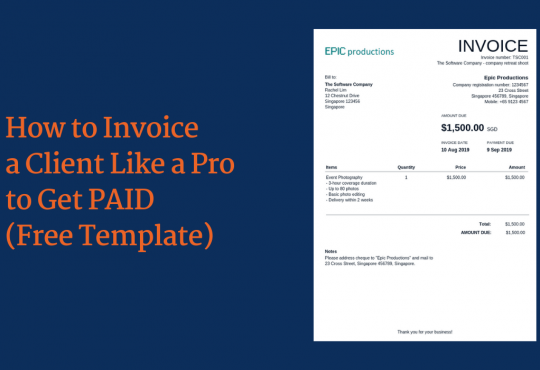
How to invoice clients
If you want to get paid, then you’ll need to send your clients an invoice. But how do you prepare one?
I published a blog post about this in 2019, but it got outdated. For example, it recommended And Co and Wave as free invoicing software options even though they’re no longer available to Singapore freelancers.
So, I did a light refresh of the post. I also took the opportunity to cover how to use AI tools like ChatGPT and Claude to generate invoices since it’s now 2026.
Check out the updated article here. Thanks to newsletter subscriber E for alerting me to the outdated post!
How the haze has impacted self-employed persons
Last week’s haze situation in Singapore was pretty bad. I stayed indoors as much as possible, including avoiding certain eateries because they only had outdoor seating. Fortunately, I can work indoors, but I couldn’t help but think about others, like construction workers, who work outdoors and possibly without protection from face masks.
News outlets published a few articles about the haze’s impact on self-employed persons. Outdoor coaches lost income as they were forced to cancel classes, including after their lesson venues were temporarily closed.
Separately, some delivery riders decided to work less. The Acting Minister for Manpower also came out to say that platform operators shouldn’t penalise platform workers who take longer to complete jobs amid the haze.
Air quality has improved over the last few days, so let’s hope things stay this way—or even return to normal soon. Stay safe, all!
This post was first published in my email newsletter on 22 Oct 2026. If you liked it, sign up for my newsletter here: